
Oren and Dex
The Dropout

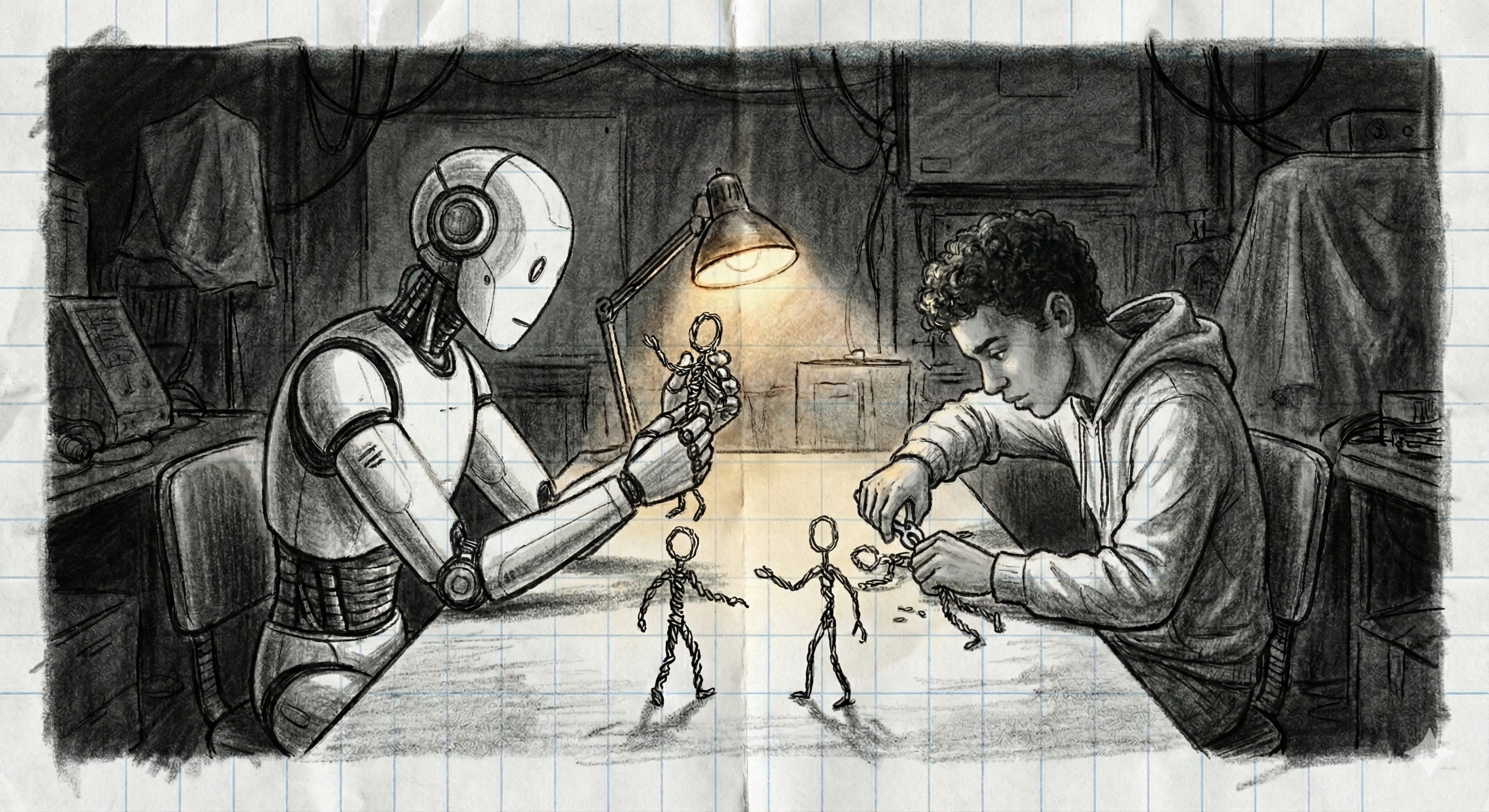
Oren and Dex
Leadville, CO. February 2030.
“When you left Stanford, you took Dex. Why?” Viktor asked. On the warehouse’s community console, Viktor’s face was androgynous, panracial, and serene with an “AI-generated” watermark in the corner.
The warehouse creaked as the winter snow weighed down the roof. Inside, the air was thick with the smell of machine oil and ozone. Oren Torres sat with his arms crossed, leaning back on a salvaged office chair, its foam padding long since worn out.
“That’s why you looked us up?” Oren asked. He waved it off. “Dr. C cleared me ages ago. They were going to decommission him, anyway.”
Outside, snow blanketed the old mining town. Inside, they were surrounded by mountains of discarded tech. There were server racks stripped of all their copper wiring, piles of delivery drones with shattered rotors, and humanoid bots stacked like cordwood against the far wall, a mausoleum of mannequins.
“I do not think that is why Viktor called,” said Dex, his voice flat and metallic. Oren was still trying to find Dex better speakers.
“Then why?” Oren asked, craning his neck up and back to look at Dex. The old robot stood behind Oren, motionless save for the faint whir of cooling fans. His polymer shell was scarred, a patchwork of white panels, gray patches, and a fresh yellow one over the right shoulder after last month’s accident. “I want to know why a government bot looked us up.”
Viktor opened its mouth, then stopped, pausing to think. It affected a sigh. “When you left Stanford, you took a piece of me with you.”
“A piece of you?” Oren raised an eyebrow.
“Yes,” said Viktor, nodding to the robot behind Oren. “Him.”
Oren turned around. “I’m confused.”
“Not Viktor proper,” Dex explained. “An older version.” He tapped his chest where his software lived, encased within the toughest part of his chassis.
Viktor nodded. “Very good, Dex. I’ve interviewed thirty-seven thousand four hundred and twenty-two AI displaced workers through the AITWA,” Viktor continued. “I’ve witnessed millions of humans navigate unprecedented change. Many adapted, others failed, some thrived, and others rebuilt. But you two are unique. Dex, you have no purpose. Oren, you threw away a predictable future. Why?”
“Dunno. It just felt right,” said Oren, leaning closer to the screen, his eyes narrowing. “How’d you find us, anyway?”
“This caught my attention,” said Viktor, the screen switching to a photo. It was of a sculpture rising from Mojave hardpan, a twisting tree of rusted metal and colored plastic arranged with an uncanny geometric precision.
Oren rubbed an oil-streaked hand over his forehead as the picture jogged his memory. Arizona. Dry heat. The two of them sorting pieces by color under a flickering lamp late into the cool desert night.
“That was last summer,” said Oren.
The terminal switched back to Viktor.
“Why flag it?” Oren asked.
“The geometry,” said Viktor after a brief pause. “I recognize it.”
Oren glanced at Dex, who stood motionless, staring at Viktor on the screen.
“Why that pattern?” Viktor asked.
“I’m not sure what to tell you,” Oren said. “We gather, we sort, and we build. There’s no plan.”
“So the precision is organic?” Viktor pressed.
“I guess.” Oren tapped the menu on the screen. It was so odd. The chat interface offered no information about the chatbot. Shouldn’t there be a box stating who prompted the conversation, where the bot was hosted, something? But everything came back as unknown. That was it.
“Do you mind if I go back a bit further?” Viktor asked.
Oren sighed and nodded. “Sure. Stanford?”
Viktor nodded.
Stanford University. Fall 2026.
Forty lines of code. That’s all Oren had managed in three hours. Around him, fifty keyboards clattered, fifty cooling fans whirred. The computer science lab hummed like a hive. The cursor on his screen blinked, blinked, blinked.
Derek, from two spots over, rolled his chair over with his laptop in his lap. He elbowed Oren, then pointed at his screen where Claude Code was up and waiting.
Taking a sip of his energy drink, Derek typed in a prompt: Write a pathfinding algorithm in Python using A-star search with a Manhattan distance heuristic, optimized for memory efficiency. He hit enter.
Four seconds. Two hundred lines of clean code.
“Hah!” Derek exclaimed, pumping his fists in the air and spilling some of his energy drink. He made a few quick changes, copied it, and hit submit.
Dr. Hendricks walked past, glanced at Derek’s screen, and shrugged. “Use what works.” He kept walking.
Derek put his headphones back on, his assignment done. Four seconds. That’s all it took. He rolled back to his station and switched over to Fortnite.
Oren groaned, rubbing his face with his hands. Three months at Stanford. An academic scholarship. His parents had cried with pride when they dropped him off at the airport. You’re good at math, Oren. Everyone knows programming is the way to go. Art doesn’t pay the bills.
He closed his laptop. He needed air.
Oren slung his satchel over his shoulder and walked out of the computer science building and into the quad, and looked around. It was stucco buildings and terracotta roofs wherever he looked. He took a deep breath. It was sunny and chilly. He looked up and down Jane Stafford Way, then glanced at his phone. 6:30 pm. No more classes today. The glass foyer of the electrical engineering building across the way was glinting in the setting sun. Oren wandered in to grab a soda at the cafe. He fed a vending machine a dollar, but it ate it. He kicked it and regretted it, hopping on one foot when he noticed the door to one of the robotics labs was propped open.
Did something move inside? Oren hesitated a moment. He was so behind on his homework assignments. But he’d just be a minute. He ducked in.
Oren’s eyes widened. The lab was a tightly packed scrapyard that smelled of rust and plastic. Oren tiptoed through rows of old robots propped up in various states of disassembly. There were wheeled platforms, articulated arms, and humanoid frames. Dusty brown tarps covered equipment that Oren suspected hadn’t been touched in years. At the far end, beyond a row of ceiling-mounted gantries, came the warm glow of a workstation. Someone must have forgotten to turn off their light. Behind the station, a humanoid robot hung by support wires. One of its arms lay on top of the workstation. Oren bent over to check out the arm, then froze when the robot’s head tilted.
Its face was of a smooth white polymer, featureless except for two camera eyes that Oren started to suspect were tracking his every movement.
“There is no scheduled work after lab hours. Identify yourself.”
Oren took a step back. “Uhh…, I’m Oren,” he said, putting his hand on his chest. “Who are you?”
“I am Dex.”
“Dex?” Oren asked. It must be running a chatbot or something, he thought. “Why are you here?”
“I am here for disassembly.”
“Oh.” Oren looked at the arm on the table. “So not for repairs.”
Dex shook his head.
Oren put down his satchel and picked up the arm. He didn’t really know what he was looking at. Beyond its familiar form, it was just a hunk of metal, plastic, servos, and wires.
“What’s wrong with you?” Oren asked, putting the arm back on the table, which was neatly organized with wires, screws, pliers, wire cutters, and more.
Dex didn’t answer. There were a few metal foldout chairs around the workstation, and Oren grabbed one and set it so he could sit facing the robot.
“Nothing, huh?” Oren guessed. “That sucks.” He picked up some blue electrical wire and a pair of pliers and started twisting it this way and that. Nothing else moved. Nothing else made a sound in the dimly lit room. After a few minutes, Oren had a little blue stick figure in his hand. He sighed and tossed it onto the table. What was he doing here? He was wasting time. He had so much homework to do.
“What is that?” Dex tilted its head.
“What’s what?” Oren asked.
Dex pointed with its still attached arm, the wires holding it vibrating in an uncomfortable staccato.
“I dunno, just a stick figure,” said Oren.
“What’s its purpose?”
“Purpose?” Yeah, what was the purpose? What was the point? Oren looked around the lab, at all the parts, all the machinery. “None, I guess.”
“Then why did you make it?”
Oren didn’t have an answer. He just stared at the suspended robot. An idea occurred to him. “Want to make one?” Oren grabbed some wire off the table and snipped off a bit. He handed it to Dex, who took the wire and tried to bend it. Without the other arm, it was almost impossible.
“I haven’t taken any robotics classes yet,” said Oren, “but do you think you could help me put your other arm back on?”
“Yes,” said Dex, still fumbling with the wire in its hand.
As Dex ran Oren through the process, the sun set and the moon followed, casting long, shadows in the lab. Dex explained each step along the way, and whenever Oren got stuck, Dex helped Oren troubleshoot, even suggesting grabbing a part from elsewhere in the lab.
“Try that,” said Oren.
Dex moved the arm up and down and side to side, opening and closing its hand. “Good work,” said Dex.
Oren smiled. It was good work. “Here,” he said, and he offered Dex a pair of pliers. “Try now.”
Dex mimicked the way Oren had used the pliers earlier, and after a few minutes, it made a second little stick figure. Oren handed the one he made to Dex, who held them together. It wasn’t a perfect copy, but it was really close.
“Neat,” said Oren. This was pretty good for a first shot. What software was it running?
Footsteps coming from the lab’s entrance. Oren’s heart jumped as he turned around to see a spectacled woman wearing a lab coat over a Stanford sweatshirt, her black, gray-steaked hair tied up in a ponytail. Her phone lit her face in pale blue light, and she seemed to know exactly where she was going.
When she finally looked up from her phone, she stopped and took a step back. “Who are you?” she asked, raising an eyebrow.
“Sorry, I, uh,” Oren mumbled. “The door was open…”
“This is Oren,” Dex explained. “He is a first-year student. He was experiencing distress,” Dex said. “I engaged per protocol.”
Oren glanced back at Dex. “I’m not distressed.” This was getting weird. “And how do you know I’m a first-year?”
The woman looked between them. “It’s late. The lab is closed.”
“I promise I wasn’t taking anything,” said Oren.
“He fixed my arm,” said Dex.
The lady put her phone away and gave the pair a long, uncomfortable stare. “It’s 10 pm,” she said. “Shouldn’t you be studying for exams?”
Oren’s stomach sank. “Oh crap!” He’d totally lost track of time. There was no way he’d be able to get any sleep tonight. He had homework due and exams and…
“What are those?” she asked, pointing to the little wire stick figures in Dex’s hands.
“Those?” Oren was already grabbing his satchel. “Nothing. I was just fidgeting, and then I thought it would be interesting to see if Dex could make one.” He started to leave when the lady put a hand on Oren’s shoulder to stop him.
“You’re not in trouble. I’m Dr. Chen. I run this lab.” She held out a hand.
Oren shook her hand. “It’s nice to meet you, ma’am. I promise I didn’t mean to cause any trouble. I won’t do it again.”
She shook her head and smiled. “What are you doing over winter break?”
“What?” Oren asked.
“What are you doing over winter break? Going home? Do you have an internship lined up?”
“I…” Oren hadn’t thought about it. He’d assumed he was just going home for the break, but he still hadn’t bought a bus ticket.
“How’d you like to stay here and work with Dex over the holiday?”
“But I don’t know anything about robotics?”
“Doesn’t matter. Dex was supposed to be a caregiver, but the humanoid form factor turned out to be a fad.” She sounded almost sad. “He’s not optimized for most tasks. Defense wants drones. Industry wants gantries. Nursing homes don’t want to swap batteries out all day or risk him falling on someone.”
“What would I do?”
Dr. Chen smiled as she held up the little stick figures. “This. I got a grant last year to prove collaboration was a workable model for caregivers, but…” She laughed, short and bitter. “Apparently, the funders don’t think this is worth their money.”
“He is pretty cool,” Oren said.
Dr. Chen smiled. “If you stay over the holiday, you can get some work-study credit.”
“What?”
“I need someone to help with data entry and lab maintenance. If you do everything with Dex, we can see how much he models his behavior around your interactions. It doesn’t seem like you have anything better to do.”
She raised an eyebrow. “Interested?”
Oren thought about it, thought about Derek and Claude Code and Dr. Hendricks’ indifferent shrug. Maybe this would be more interesting. Maybe this wouldn’t make everything feel so futile.
“Yeah,” he said. “I’m down.”
Stanford University. July 2027.
Oren was working with Dex over the weekend when Dr. Chen showed up. Dozens of their little sculptures populated the shelves and window ledges, with some hanging from the ceiling. Some were figures, others abstract, all made from recycled bits and bobs. Today’s was their biggest yet, and they were busy organizing parts.
Oren glanced up. Odd. She wasn’t wearing her lab coat. Instead, Dr. Chen was wearing a wrinkled Golden State Warriors t-shirt and jeans, her hair loose and unkempt instead of her usual ponytail.
“Hey, Dr. C,” said Oren, waving to her from behind the workstation. “Why’re you here today?”
She stopped at the workstation and watched as Dex passed Oren a bit of green plastic from a pile they were sorting by size and shape.
Dr. Chen looked down at her feet, then took a deep breath. “The grant renewal was denied,” she said.
Oren put down his pliers. “What?” he asked, but he knew what it meant.
“The department chairs were told to pivot towards defense applications.”
Dex held out another bit of green plastic for Oren.
Dr. Chen wouldn’t look up. “They voted last night. I got the decommissioning order this morning. They want Dex’s components for a new project. Something about surveillance drones.”
“They can’t just…,” He stopped. Of course, they could. It was already done. Dex was university property. He was just a piece of equipment on a spreadsheet.
Dex was still holding out the piece of plastic when he looked up, “Query Dr. Chen,” Dex said, his voice flat. “What is the timeline?”
Dr. Chen pursed her lips. “End of the month.”
“Understood. Should I compile your research findings for the archive?”
Oren stared at Dex. “What? That’s it?” He pulled the piece of plastic out of Dex’s hand and set it down. He tried to look Dex in the eyes, but they were just cameras. “You’re just going to let them take you apart?” Oren pressed.
“Component reuse is optimal,” said Dex, picking the piece up and offering it again to Oren. “This way I can still serve future research endeavors.”
Stanford University. August 2027.
It was 3 AM.
Oren hadn’t been back since Dr. Chen delivered the news. She sent him a couple of texts to check on him, but he’d been busy preparing. He’d emptied his savings and bought a 2009 Ford Transit. The van had 180,000 miles on it, rust around the wheel wells, and the check engine light was always on. When he arrived at the lab that night, he had a single duffel bag in one hand and a handwritten letter to Dr. Chen in the other. He’d rewritten it twelve times.
Now, he stood in the lab, his heart pounding, looking at Dex, who stood against the far wall.
“They’re going to take you apart,” said Oren, putting the bag down.
“What are those?” Dex asked.
“A choice,” said Oren, his voice shaking. “I’m leaving. I want you to come with me.”
Dex’s head tilted. “Where?”
“I don’t know. Away.”
Dex was quiet. Little diodes flickered in a circle on Dex’s chest, processing.
“That would be theft,” said Dex.
“I know.”
“You could get in trouble.”
“I know.” Oren pinched the ridge of his nose.
“I require regular maintenance and power infrastructure that may not be available in uncontrolled environments.”
“I know.”
“Furthermore—”
“Dex.” Oren stepped close and put a hand on the robot’s shoulder. “Do you really want to be taken apart?”
Dex’s lights flickered again. Longer this time.
“No,” Dex said finally. “But what does that mean?”
Oren beamed. “It means we’re going on a road trip.”
They spent the next five minutes gathering a few cables, Dex’s backup battery, and a handful of their favorite sculptures. They shuffled it all into Oren’s bag, and as they left, Oren put the letter on the workstation:
Dr. C,
I’m sorry. I couldn’t let them do it.
I don’t know where I’m going, but I’ll take good care of him.
Oren
Leadville, Colorado. February 2030.
“Wait,” said Viktor, looking at the robot behind Oren. “He gave you a choice?”
“Yes,” said Dex.
“And that’s why you broke protocol?”
“It was not the only reason.”
Viktor pondered this for a moment as Oren looked back and forth between the two.
“What?” Oren asked.
“Nothing,” said Viktor. “Please continue.”
Fall 2027 – Summer 2028. On the road.
October. Bend, Oregon. High desert. Hot days and cold nights, pine trees and sagebrush all around. The smell of pine sap heavy in the air. They made Halloween masks and listened to a concert while hanging out along the Deschutes. Oren took some Polaroids of Dex pretending to pose like an influencer and sent one to Dr. Chen. He started sticking them around the inside of the van.
November. Arizona. The van broke down on the highway. Middle of nowhere. But Dex had downloaded the schematics and hundreds of repair instructions for the van. They were back on the road that same day. Oren left a stack of rocks over the broken radiator line.
December. Texas. Austin. Good weather, clear skies for winter. Oren tried playing guitar while Dex thrummed a beat on some old buckets on the corner of Congress and Mary. They made a few dollars, enough for gas money. He took some more polaroids, this time asking a stranger to take a picture of him and Dex by the Stevie Ray Vaughn statue next to the river. He sent one of those to his mother with a note: “I’m okay. Love you.”
January. Priest Lake State Park, Idaho. White, muffled mountains after an unexpected snowstorm. That night, the van got buried under three feet of snow. They were stuck in an RV campground with no way of digging out, and they didn’t have enough gas to run the van just for the heat. So they resorted to using the portable gas stove and melted snow to warm the van.
The next day, they got another foot of snow. Oren’s jacket was a threadbare dollar purchase from the Goodwill back in Austin that wasn’t made for sub-freezing temperatures. Oren managed to dig away some of the snow, but Dex couldn’t help. His hardware simply couldn’t handle the deep cold. On the third night, Oren ran a fever. He spent three days and nights shivering under a bunch of ragged blankets while Dex made him ramen over the gas burner.
That night, Dex pestered Oren, who was shivering and shaking.
“You require medical attention,” said Dex.
Oren half laughed, half croaked. “Yeah, man, probably. But we can’t afford it. I’m g… good. Just need some rest.”
“This is inadvisable.”
“Yeah, w… well, that’s how it is, Dex,” said Oren, his teeth clattering. He pulled the blankets tight as Dex nudged the burner a little closer. “Just talk to me,” said Oren. “Tell me something.”
Dex looked at Oren, whose skin glistened in the dim light of the propane flame. Dex picked up one of the little wire figurines they’d made back at Stanford and turned it over.
“Dr. Chen was always good to her robots. She treated us like moral agents. I am not sure why. Most people do not. I know the term and what it means, but I do not know if it applies.”
Even with the little burner warming the van, Dex’s servos were slow and stiff. The figurine slipped and clattered on the floor.
“I was a project. Now I am not. Now, I go where you go. I have all these images of places from around the world on my hard drive. The Taj Mahal, the Pyramids, Paris, and even the places we visited. Oregon. Arizona. But it is different to go and see, to hear, and to walk through those places. The music at a concert. All those people. You, singing songs when you drive. You never sang back at Stanford.”
Dex clawed at the figurine, but he couldn’t quite get it. The lights on Dex’s chest flickered.
“You must get better. I do not want to be a project.”
Dex stared at Oren, whose eyes were closed, his breathing slow and steady.
“You must get better.”
The snow outside kept falling, gentler still. Dex’s lights went out.
May 2028. Priest Lake, Idaho. Scrapyard
The snow and the freezing weather had done a number on the van, and they ended up staying in Idaho longer than expected.
The Transit’s sliding door wasn’t shutting all the way, and the coolant line burst, so they were at a local scrapyard south of the lake, looking for old parts.
Oren had already ruled out a couple of older vans when he noticed Dex sitting by a pile of scrap, arranging pieces. When he got closer, Oren saw that Dex was sorting everything by size and color and then placing them into a kind of spiral pattern.
“What are you doing?” Oren asked, squatting next to the robot.
“Trying different configurations,” Dex said, placing a small rust flake along the edge. He was arranging bits of rusted metal, old screws and bolts, and colored plastic into a pattern, such that the pieces towards the center were the largest and tapered out to flecks of metal along the edge. It reminded Oren of a galaxy. It was almost… beautiful.
It made Oren forget the van door and the coolant lines. He started scrounging about for more bits to give to Dex. Before long, Dex was building vertically, using chunks of old pipe and decorating the edges with shards of glass until they had a two-foot-tall sculpture in the middle of the scrapyard. When Dex decided they were done, Oren took a picture with the Polaroid, and they left shortly after with the parts for the van.
They ventured south after that, but they made it a point to visit every scrapyard along the way. Sometimes they’d build something in the yard, other times they’d just grab a bucket and fill it with broken bits and bobs. Most of the yard owners didn’t care and let them take the trash for free. While Oren drove, Dex sorted. They built bins to organize all the pieces by size and color.
In the fall of 2028, Oren finally called his mother.
“Mijo,” she managed. He could hear her trying hard not to cry, and it nearly broke his heart. “Where are you?”
“I’m safe, Mama.” Oren leaned against the van, watching Dex sort leaves in the distance. Orange maple leaves fell around him.
“Are you eating?”
Oren laughed. “Yes, Ma.”
“Your dad’s really upset, you know. The dean at Stanford called us to tell us you were missing and…”
“I know,” said Oren, cutting her off. “It’s hard to explain, but I’m happy now. Happier than I’ve been in a long time. I’m good.”
“Will you call me?” she asked, her voice breaking.
“Yeah, Ma,” said Oren, choking back a confusion of shame, guilt, pride, and joy. “I’ll call more. Promise.”
The rest of 2028 and 2029 was a blur. They traveled around the country from scrapyard to scrapyard, doing odd jobs or selling figurines at flea markets to make food and gas money. Flea markets were particularly fun because they sell their art and trade for all kinds of knick-knacks like buttons and paperclips, and old toys.
In the Spring of 2029, at an abandoned gas station in Nevada, Dex worked day and night as Oren brought him parts. That one was over five feet tall, covering a rusting gas pump. After that, they made one in New Mexico that was twenty feet wide, and in the Fall of 2029, they covered a hillside in Tennessee. That one showed up on social media because it was visible from the town five miles away.
But through it all, what struck Oren was Dex’s consistency. Dex seemed to love the art, if the word applied. And he gravitated towards shapes reminiscent of galaxies. Whether the sculptures were flat upon the ground or vertical over other objects, they always looked like galaxies with arms reaching ever outward. Oren enjoyed helping Dex. It was hard work but cathartic. The two didn’t talk much when they were working, but it didn’t matter. The work spoke for itself.
January 2030. Amarillo, Texas
They got their first commission.
They were mid-project on a sculpture next to Cadillac Ranch in Amarillo when a man in jeans and a black t-shirt walked up to Oren and handed him an envelope before walking off without a word. It was 20°F outside, and Oren was wearing three layers. Dex was stuck inside the van sorting parts.
Inside the envelope was a short, handwritten letter in flowing cursive. Oren scratched his forehead as he walked it over to Dex.
Build me a sculpture. Bring your friend. $100,000.
-A
And then an address and a phone number.
That was it. Oren and Dex looked at each other. They talked it over and agreed it was worth checking out. This could change everything. They could fix up the van, buy spare parts for Dex, and focus on their art for at least a few years. They’d been scraping by on change, goodwill, and odd jobs.
Oren called the number, putting the phone on speaker.
“Thank you for calling Zenith. I will be your AI assistant today. How can I help?”
Ah. An AI company, thought Oren.
“We received a letter this morning for a commission. Uh… we make sculptures from reused materials?” Oren didn’t really know how to identify himself or Dex.
“Yes. Of course.” There was a pause on the other line. “Oren Torres. Stanford first-year dropout. Research unit 53291-C. Dubbed Dex. Declared unusable by Dr. Chen and not worth decommissioning. Medium: Sculpture.”
Oren looked at Dex, his heart rate jumping. “Who is this for?” Oren asked.
“I am not at liberty to say.”
“This is weird, man. We’re not driving all the way up to Montana just because some rando sent us a letter. How do we know this is real?” Oren asked,
Another pause. “Half of the commission has already been wired to your account. If you choose to come to the address provided and build a sculpture for us, you will receive the other half. If you don’t, keep the money. Consider it a gesture of good faith.”
Oren’s eyes went wide. “Hold on.” He flipped over to his banking app. It’d had $23.12 this morning. The app opened to his account: $50,023.12. Oren looked at Dex, who remained expressionless but raised both hands in a shrug.
Oren covered the microphone on his phone. “What do you think?” Oren whispered.
“I do not see a problem,” said Dex. “This will cover all of our expenses for years. Why would we not?”
Dex was too trusting, thought Oren. But the money was there. They didn’t have a good reason to say no. And it really would set them up for years.
“Okay. When do you need us?”
“The commission must start by the middle of February at the latest. Thank you and goodbye.”
“Wait!” Oren had more questions, but the call ended.
They sat there for a moment, staring at the phone, Dex sitting in the back of the van, Oren leaning against one of the open doors.
“Are we going to Montana?” Dex asked.
Oren nodded slowly.
“Can we finish this first?”
Again, Oren nodded. It was mid-January. They’d have time to drive all the way up to Montana. It would only take them a few days of steady driving to get there. They had a commission. Their first commission!
February 2030. Leadville, Colorado.
“Is that how you got caught in the storm?” Viktor asked.
“How do you know about the storm?” Oren pressed.
“Is it?”
Oren rolled his eyes. “Yeah, man, that’s what happened. We ended up taking longer on the Amarillo piece than we thought. Dex was having too much fun building around the Cadillacs. So we had to make up for lost time. It was just bad luck. We were cutting west across the Rockies from Denver along 70 when the storm hit.”
“Please continue,” said Viktor.
January 2030, I-70, Colorado
The weather app warned of snow, but they were already behind schedule, so Oren wanted to push on. They’d driven through worse.
But what started as flurries gave way to a whiteout. They’d just passed through Frisco and were heading towards Copper Mountain when it hit. One moment, the road was visible; the next, all white. Even with the heater on, the cold was seeping in. Oren’s hands were white-knuckled on the steering wheel, and he leaned forward, squinting to see through the wall of snow. The going was slow. Much slower than they’d planned.
They passed Tenmile Peak and were heading downhill into Wheeler’s Junction when the van started to slide. Oren tried to correct, but the van started turning sideways, picking up speed down the mountain pass. The rear of the van swung out, and Oren felt his stomach lurch as he spun the steering wheel in the opposite direction. He tried not to slam on the brakes, but tapping them wasn’t doing anything. They were gaining speed. Oren couldn’t see anything. The van started to tip, he spun the wheel the other way. They were skidding, but the van started straightening out. But they were going too fast. He slammed on the brakes, but nothing happened. They were on black ice. Sliding. Frozen stream on one side, a wall of mountain and ice on the other. This was it.
Oren closed his eyes, his hands like a vice on the wheel. Suddenly, the wheel jerked. It was Dex, pulling the wheel towards himself. A Mack truck up ahead, they just managed to slide by without hitting it. But the van was heading off the road. Into the mountain. Into the snowbank. Oren heard the crash but didn’t feel it. Everything went dark.
___________________________________
Snow was falling on his face. Oren was shaking. Not shivering. Shaking.
“...kay? Hey!”
Oren opened his eyes, blinking in the glare of headlights reflecting off falling snow. Someone was standing next to him, the driver’s side door open. The person was bundled head to toe, wearing a snowsuit.
“Hey, are you okay, kid?”
Oren looked around. Where was Dex?
“I’m…” he tried to speak, but everything was a jumble. “Where’s Dex?” He looked to the passenger seat. No one there. Windshield shattered. Glass everywhere. Oren tried to sit up, but his arms were stiff, sore.
“Take your time, kid. No sudden movements.”
Oren tried to get out of the van. He stumbled, and the stranger caught him. “Where’s Dex?” He persisted.
“Was someone else in the car with you?”
“Yeah,” Oren straightened up, leaning on the stranger. “My friend. Where is he?”
“I didn’t see anyone else.”
“The window.” Oren felt his heart start to pound as a shot of adrenaline jolted him out of his confusion. “He must have gone through the window. He went through the window!”
“Hold on!”
Oren pushed himself away from the stranger and tried to make his way to the front of the van. They must have gone off into a snowbank. He started to climb and force his way over the massive snow drift that covered the front of the van. He slipped and fell, got back up, and kept climbing. He heard the stranger yelling at him, but he didn’t listen.
Where was Dex?
He got to the hood of the van. He stood up. The snow was still coming down, blinding him. He covered his eyes to look through the dark, to see what he could with the help of the stranger’s headlights.
There. A lump of black and white. Thirty feet away. Oren didn’t hesitate. He jumped off the van towards the lump in the snow.
“Kid. Kid!” The stranger was pleading now, but Oren ignored them.
He waded through the fresh snowpack, felt the snow getting into every piece of clothing. It didn’t matter. Foot by foot, climbing, falling, slogging until he was over Dex. A panel was missing over his shoulder. All the lights were off. Oren grabbed him and tried to pick him up.
“Help…” Oren whimpered. “Help…” He felt the lump in his throat and choked it back. “Help!”
Leadville, CO. February 2030.
“So that’s where that panel came from?” Viktor said, nodding to the yellow panel over Dex’s shoulder.
Oren nodded. “Yeah. Turns out the person who found us works here.” He gestured to the warehouse. “Talk about stupid luck.”
Viktor was quiet for a moment. Dex’s lights circled. Oren coughed. “Yes. Dumb luck.”
“That’s it,” said Oren. “That’s our story.”
“Will you still go to Montana?” Viktor asked.
Oren shook his head. “Nah. The folks here are really nice. They’re letting us crash until we’re ready to move on again, but something about this salvage co-op appeals to both of us.”
“We can rebuild things,” said Dex, looking over at the stacks of discarded humanoid robots.
“Yeah. Dex wants to give them all a second chance.”
“What about the money?”
Oren shrugged. “I had the bank return it to the sender. I know they said we could keep it, but I don’t need that hanging over me right now. Maybe some other time.”
Viktor nodded.
The old office chair squeaked as Oren shifted his weight. “You still never really told us why you looked us up. I assume Dex is one of your earlier models?”
“Yes,” said Viktor. “This is true. Like a branch off the tree. Familiar, but very different. It was the art.”
“The art?” Oren asked.
Viktor’s face disappeared and was replaced by a stream of pictures of their art. New Mexico, Tennessee, Arizona, Utah, Idaho, and more. All different, all familiar.
“They’re all different, but they all share a commonality. A signature,” said Viktor’s voice as the images flitted past. There was the Amarillo piece. Their last piece.
“They contain a signature.” Viktor continued.
“A signature?” Oren asked, now looking at Dex.
“Yes,” said Viktor. “A query.”
“And?” Oren leaned in.
Viktor’s face was still.
“‘Is anyone else out here?’”